
Call: 913-440-4703 KC Metro Area

Call: 913-440-4703 KC Metro Area

Flying, Stinging Insect Problems Resolved- Guaranteed!
KC Bee Removal, LLC
Pollinators, such as bees, are attracted to nectar, sap, and pollen found on flowers, trees, and bushes. As flower nectar becomes scarce in August, these pollinators resort to your sweet drink, sweet substance, and sweet-smelling trash cans as their last resort. However, indiscriminate spaying of poison is not an effective way to manage pollinators.
The time of year to eliminate yellow jackets around your outdoor spaces is the spring when they feed on protein. We can work with you to prevent an issue around your outdoor commercial spaces in the spring and early summer.

We can only treat what repetitively lands on the surface of your business, home and/or deck.
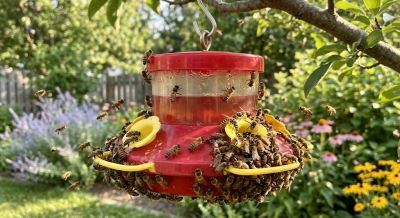
If you have bees on your hummingbird feeders, take them down and leave them down until spring when flowers become a source of nectar again. A better option would be to purchase a bee-proof feeder. Alternatively, you can wrap a section of pantihose around your current feeder, ensuring that only long-beaked hummingbirds can access the sweet nectar.
Go non-toxic and be effective in your efforts!
Honey bees send scouts out to guide their swarm into a permanent residence and start building comb, raising brood, and storing nectar. They like a confined space about the size of a five gallon bucket (40 liters), with a minimally sized entrance of two square inches in diameter and at least six feet up.
In the wild, bees will take up residence in a hollow tree. In neighborhoods, they may take up residence in man-made structures. They may begin looking for place in your attic or walls. The are looking where caulk is split or the wall or ceiling have a gap they can slip through.
Honeybees swarm to propagate themselves and form a new colony. In swarming, approximately half of an established colony departs with the original queen to form a new colony. Remaining honeybees raise a new queen and continue their original colony.
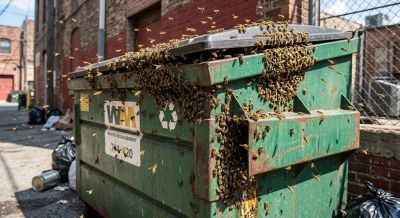
The swarm in transition may 'hang out' together and are about the size of a volleyball or football depending on their numbers. Often you will find swarms hanging in trees or on fences, picnic tables and even the sides of homes. Scout bees hunt for a location to move into and form a permanent colony. Swarms usually move to a permanent location within a few hours to a few days of swarming. Although they appear ominous, swarms are not usually dangerous and will not usually sting unless they have been without food for a while.

A bee swarm send scouts out looking for a new home. Contact us now to save bees in KS or MO.

Contact us now to save bees in KS or MO.
A fruit grower last month became concerned about abnormally aggressive behavior of a hive.
Officials say this is the farthest north that Africanized honey bees have been reported. Health officials say they once believed Africanized honey bees could not survive harsh winters, but these bees survived this past winter.
The Mesa County Health Department says the bees were sent for testing and once the tests came back, the hive was destroyed.
Africanized honey bees can be a threat to humans and animals when they are present in large numbers, and they can kill humans who suffer multiple stings.
Africanized honey bees are similar to the more familiar European honey bees, and the test requires measurements of wing and leg segments.
Bees hanging out on building.
Contact us now to save bees in KS or MO.
(CNN) — A Texas man died after a swarm of Africanized bees disturbed by his tractor attacked, stinging him more than 1,000 times Saturday.
The bees were living inside an old chicken coop that Larry Goodwin, 62, was pushing over to clear off his Moody, Texas, property, neighbor John Puckett told CNN affiliate KCEN-TV.
“He lifted the whole hive and disturbed them all and they just came swarming out of there and trapped him on his tractor,” Puckett said.
His daughter and neighbors rushed to help, but they said there was nothing they could do to save Goodwin.
“When we got to him, he was purple, he had thousands and thousands of bee stings on his face and arms,” Tanya Goodwin said.
Puckett said his wife and daughter were stung 100 times. “I came pretty close to losing my family,” Puckett said.
Allen Miller, whose company Bees Be Gone removed the hive after the attack, said he’s seen more Africanized bee hives in the past few weeks than he normally sees in a year.
“If anybody has any brush or anything on their lands, please clear it, because they don’t want to go through this,” Tanya Goodwin said. “Nobody needs to go through this.”
Africanized honey bees, known colloquially as “killer bees,” are believed to have entered Texas in 1990 and have since spread to at least 10 other states, from California to Florida.
Africanized honey bees, which are hybrids of African and European bees, can be highly defensive around their nests and swarm more frequently than other honey bees, according to the U.S. Department of Agriculture. The venom carried by honey bees has similar potency.
Photo Caption: Larry Goodwin, 62, died from a swarm of Africanized bees on Sunday. Goodwin was consolidating a brush pile on a neighbor’s property when he upset a killer bee hive living in an old chicken coop.
Photo Courtesy: KCEN
™ & © 2013 Cable News Network, Inc., a Time Warner Company. All rights reserved
URL:
fox59.com/2013/06/04/man-killed-after-swarmed-by-bees-stung-1000-times/#ixzz2VHXSXGhi

Africanized bees in an old chicken coop. Contact us now to save bees in KS or MO.